
by W. S. Merwin
Genre: Memoir
Publication Date: 2005
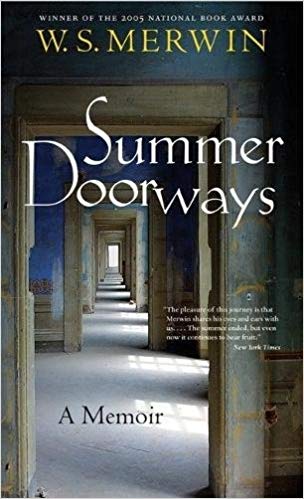
The real reason for reading this book is: BECAUSE TREES. But will expound for the wordy among us.
I talk about trees a lot. People should talk about trees more. People should talk about trees the way W. S. Merwin lived in them. He and his family built the Merwin Conservatory—19 protected acres of 400 different species. The Merwins saved a lot of trees.
**before going a letter further, I would like to take a moment of silence for W. S. Merwin (and his trees) as he died just four days ago, on March 15. I stumbled upon that little gem far too late at night, and I was ill-prepared for the news. May the Poet of the Trees live on in his words and in his forest.**
When I stumble upon a poet or writer whose work I admire, I like to read their (auto)biography. It’s another way to connect with them—plus, I just really enjoy getting to know—really know—people as best you can from a book. So, through the Summer Doorways I went.
The book carries with prose, as you might expect of a poet’s memoir. But it’s not the overall tone of nostalgia that I enjoy. It’s the retrospective analysis of how things really were, and what moments were really special.
“When I came to know Alan, I had just turned twenty and he was forty-seven. Although I had graduated Princeton and was in graduate school and married, I was still provincial, naive, and penniless. And Alan, a generation older, was worldly, knowledgeable, opinionated, and very rich. He had learned, long before that, how to appear to be frank and open, while referring to his own life with a practiced reserve, recounting moments of it with a flourish of humor, as finished anecdotes, and then stepping aside from them into the wings. It was a while before I learned to recognize the maneuver, and to see that his descriptions of his brother’s and his mother’s drunken binges and turns of unedifying behavior were cutouts: mythologized fragments held up in front of him in a way that was meant to suggest his own amiable candor about matters that he knew someone would reveal sooner or later, in any case.”
W. S. Merwin, Summer Doorways, page 20
I mean, don’t you feel like you know Alan now? Or maybe a little bit like Huh, why didn’t I think of that?
That’s the nostalgia, the epiphanies that W captures so perfectly, you actually start to remember and realize it all yourself.
I’d always wondered with poets—and artists in general—when they knew their life was destined to string words together on lines in such a way that cut through the bullshit of humanity to find the common threads. It sounds miserable because it is miserable. And apparently I’m not the only one who knew early on.
“Another waiter friend, who was privately determined by then, as I was, to be a poet, was Galway Kinnell, and he was as footloose in his outlook.”
W. S. Merwin, Summer Doorways, page 43
 Mary's One Hundred